
The Sharp Edge of Peace: What We Heard About Afghanistan, Asylum, and Local Action
AWP / FIELD · EVENT REFLECTION · NO. 1
At the launch of “Art Works Year 20,” Afghan women’s rights leaders, immigration attorneys, advocates, public officials, and community members traced a path from Afghanistan’s political crisis to the realities of asylum and resettlement in Chicago—and the responsibilities that connect them.
By Eliza O’Donnell, with Art Works Projects · September 15, 2026
On September 11, Art Works Projects and Loyola University Chicago School of Law’s Rule of Law Institute gathered Afghan women’s rights leaders, immigration attorneys, advocates, public officials, and community members for The Sharp Edge of Peace: Global Struggle and Local Action for Women’s Rights in Afghanistan. The gathering launched Art Works Year 20 with a question that has shaped AWP’s work for two decades: what happens after we bear witness?
The date carried particular weight: twenty-five years after September 11, 2001, and five years after the Taliban’s return to power in Afghanistan. The afternoon placed art and testimony at the center of a larger conversation about memory, accountability, protection, and what solidarity requires now.
An excerpt from Roya Sadat’s film The Sharp Edge of Peace, the Art Works Projects exhibition Women Between Peace and War: Afghanistan, and recent drawings by Afghan students from a rural province created the visual frame. Across three conversations, the discussion moved from women, peace, and security in Afghanistan to the U.S. asylum system, and then to the realities of resettlement in Chicago. The geography changed, but questions of dignity, accountability, and action did not.
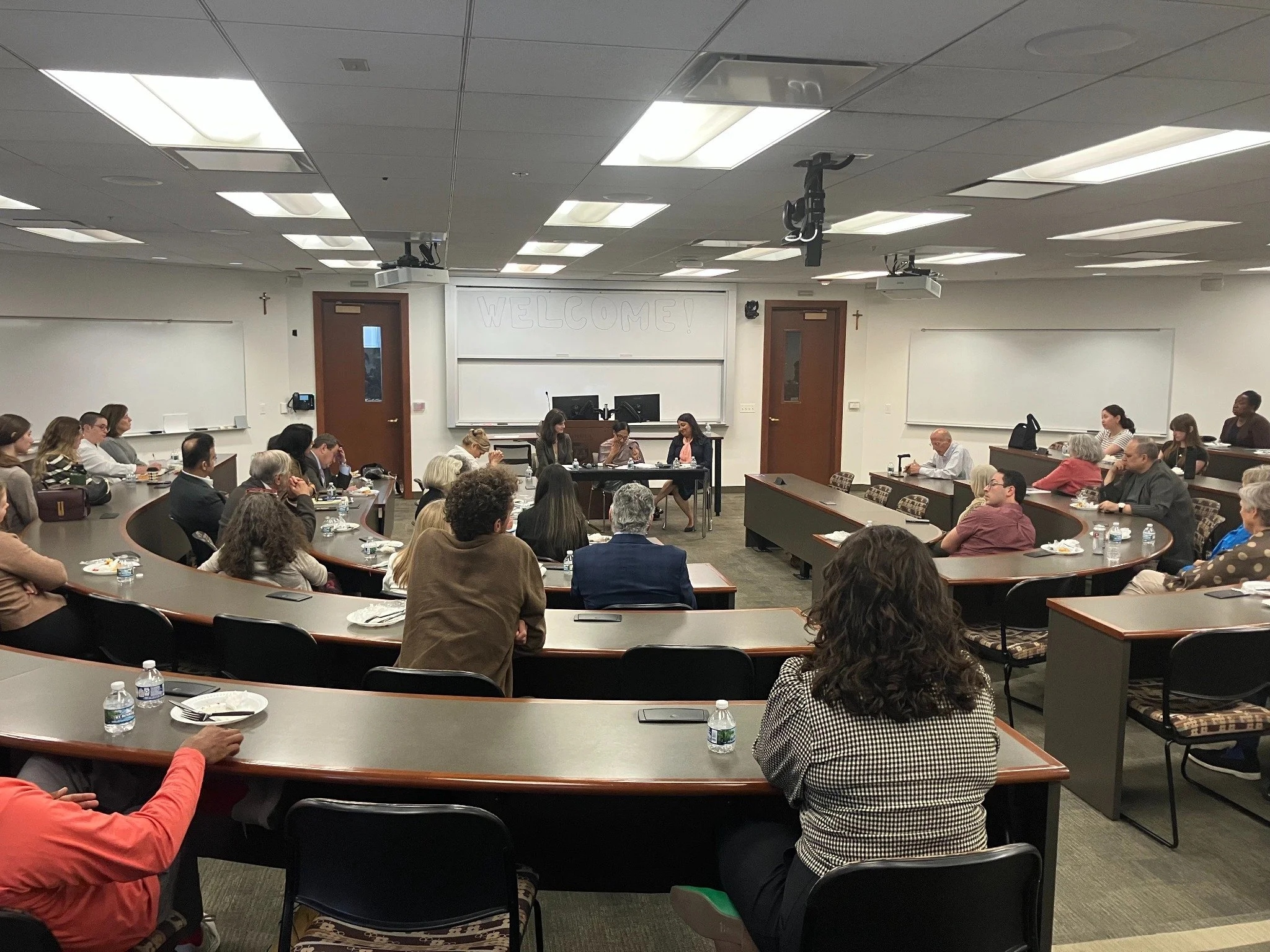
Panelists and attendees during The Sharp Edge of Peace at Loyola University Chicago School of Law, September 11, 2026.
RESISTING NORMALIZING TALIBAN RULE
The first panel, moderated by Juliet Sorensen, Director of Loyola’s Rule of Law Institute, featured human rights lawyer L. Belquis Ahmadi and development specialist Naheed Sarabi. Drawing on their experiences in Afghanistan, Ahmadi and Sarabi described how fear, uncertainty, and political change narrowed women’s public lives and eroded hard-won rights and opportunities.
They traced the Taliban’s 2021 return to power through the political decisions that preceded it. The United States and the Taliban signed the Doha agreement in 2020 without the Afghan republic as a signatory. Sarabi challenged the language of peace often attached to the agreement, arguing that it sidelined Afghans themselves and helped create the conditions for the Taliban’s return.
“The Doha agreement, referred to as the peace agreement, was instead a deal that surrendered and hand-delivered people to the Taliban. I encourage all of you, especially young people, to have a look at the agreement and what it means.”
— Naheed Sarabi
Both speakers cautioned against treating the Taliban’s continued rule as evidence of stability or moderation. Ahmadi asked the audience to look instead at the lived reality of a system in which rules are inconsistently enforced, and accountability remains absent.
“There is no consistency in how the Taliban enforce laws and regulations; there is no accountability. When a system is run on control by fear, you cannot trust the promises they make.”
— L. Belquis Ahmadi
Sarabi widened the frame; Afghanistan, she argued, can’t be treated as a crisis sealed within its own borders. The abandonment of Afghans—and the absence of meaningful accountability—carries consequences well beyond the country, including how other authoritarian and extremist movements learned what the international community will tolerate.
PROTECTION AFTER ESCAPE
The second panel, moderated by Art Works Projects Interim Executive Director Steve Bynum, turned to the U.S. and European asylum systems and protections available to those escaping persecution. Panelists Geoff Cebula of the National Immigrant Justice Center, Samuel B. Cole of the ACLU of Illinois, and immigration and human rights lawyer L. Sherizaan Minwalla, an attorney at Scott D. Pollock & Associates, discussed the legal and emotional burdens asylum seekers face, including women who flee gender-based and domestic violence.
Their discussion underscored a difficult truth: reaching safety is not the same as being secure. Legal status can remain uncertain (sometimes with intent). The asylum process can dehumanize. Immigration enforcement can deepen fear, and organizations serving refugees and asylum seekers operate in increasingly resource-deprived and treacherous environments.
The conversation also merged the global and local. Displacement may begin thousands of miles away, but its consequences are lived through local courts, legal services, resettlement organizations, workplaces, schools, neighborhoods, and public institutions. Solidarity does not stop at the border; it begs questions communities must answer close to home.
RESETTLEMENT IS NOT THE END OF THE STORY
Moderator Dr. Jessica Darrow of the University of Chicago School of Social Work opened by drawing a historical comparison between antebellum slavery and contemporary U.S. immigration and asylum policy. The discussion featured Zulikha Akrami, an advocate for women’s rights and refugee communities; Beatriz Ponce de León, Deputy Mayor for Immigration for the City of Chicago; and Rida Rashid, LCSW, of Refugee One.
Their focus was what happens after a person arrives. Resettlement does not erase trauma. It brings new pressures to become self-sufficient while rebuilding a life, a home, a sense of identity, and a community. Akrami described that process as one shaped as much by grief as by practical need.
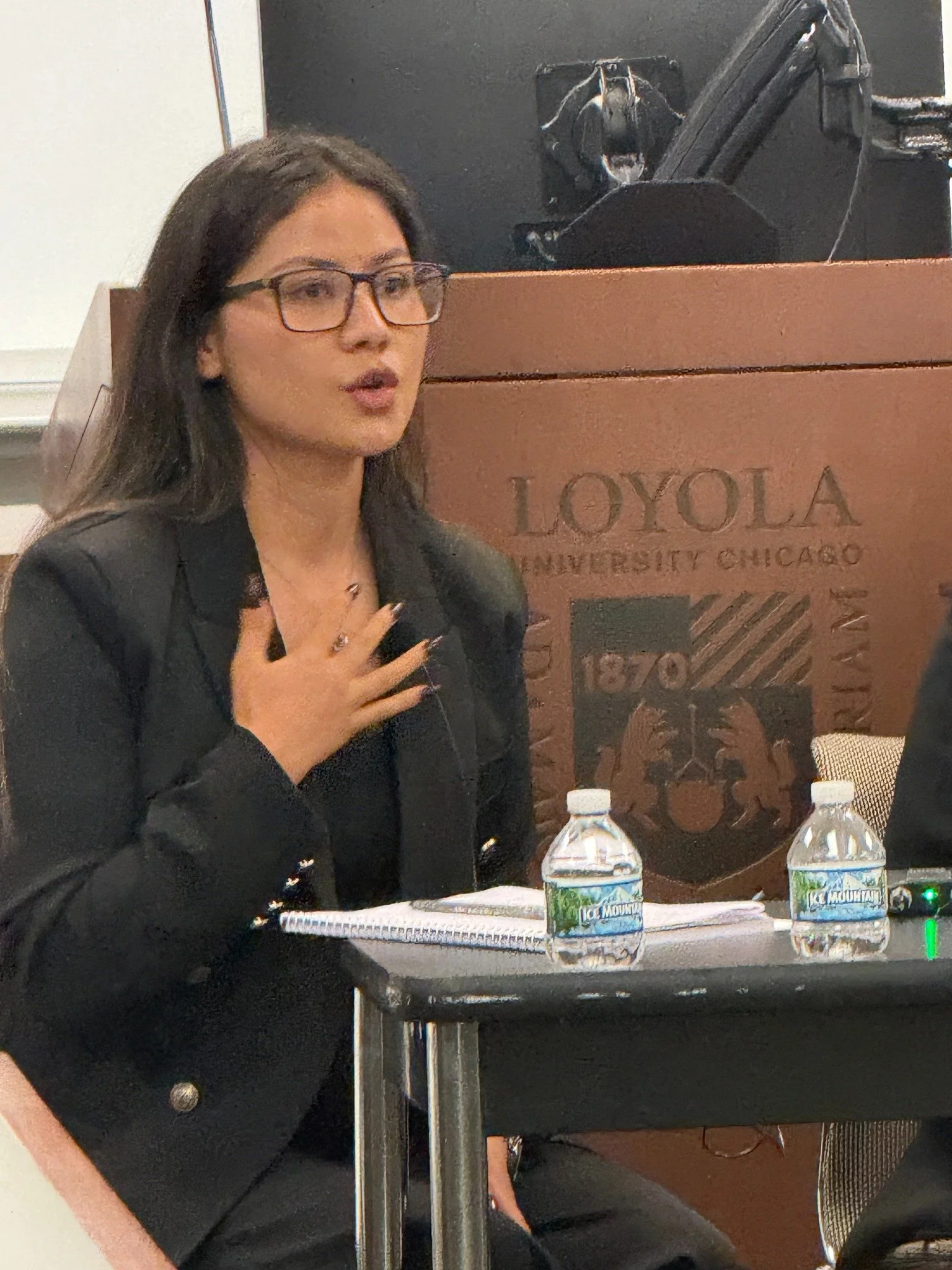
“Suddenly, I lost everything I loved overnight. I lost the version of myself I thought I would be someday.”
— Rida Rashid
Rashid’s reflection held together two realities that ran through the afternoon: some Afghans could leave, while millions could not. That reality does not leave Afghans passive or without agency. Afghan women still resist, organize, teach, advocate, and sustain community life under extraordinary oppression. People and institutions elsewhere must strengthen—not replace—that work: to protect pathways to safety, support Afghan-led advocacy, preserve testimony, and refuse to normalize systematic exclusion.
FROM WITNESS TO ACTION
The Sharp Edge of Peace did not offer an easy resolution to the crises it examined. It did something more useful: it placed testimony, art, law, policy, and lived experience in the same room and asked what responsibility follows from understanding.
For Art Works Projects, that question is central. The image is not the end of the work. Stories preserve memory, make distant realities harder to ignore, and create relationships that deepen understanding, connect people and institutions, and move toward action.
That made this gathering a fitting beginning for Art Works Year 20—not simply a look back at two decades of visual advocacy, but an invitation to carry the work onward.
“There is so much to do…let us go forward.”
— Juliet Sorensen, closing remarks
EVENT PARTNERS & SUPPORT
Presented by Art Works Projects in partnership with the Rule of Law Institute at Loyola University Chicago School of Law. Additional support came from the Gannon Center on Women and Leadership Ann F. Baum Speaker Series, Northwestern University’s Roberta Buffett Institute for Global Affairs, and Loyola University Chicago School of Law student organizations: The Art Law Society, The Immigrants’ Rights Coalition, and The International Law Society.
continue exploring
The Sharp Edge of Peace — Event & Program
Women Between Peace and War: Afghanistan
Art Works Year 20